Flag designs usually rely on simplicity. A common rule of thumb is that a flag should use no more than two or three basic colors so it can be easily recognized from a distance, even when hanging limply on a windless day.
Several nations, states and regions have completely thrown this rule out the window. By opting for more complex symbolic banners, they have created some of the most intricate designs in the world. So, which flag claims the title for the most colors? The answer depends on whether you are looking at national banners, geometric designs or those with regional coats of arms.
The National Champion: Belize
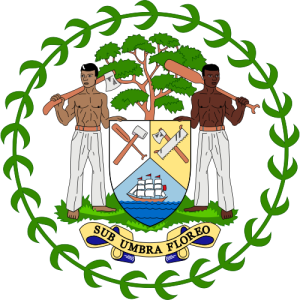
The Flag of Belize is the undisputed national champion of color. Depending on the specific design manufacturer, the flag of Belize features at least 12 distinct colors (up to 15 or more counting shading). The flag is framed by a simple royal blue background and two red horizontal stripes. The large color count comes from the intricate coat of arms placed in the center.
As explored in our guide to Flags with Human Figures, this coat of arms features two woodcutters with differing skin tones, a green mahogany tree, brown tools and a ship sailing on blue waves. Because it acts as a miniature painting rather than a simple geometric shape, Belize easily claims the top spot.
The Geometric Champions: South Africa and South Sudan
There is a distinct difference between counting the shades in a coat of arms and the core geometric blocks of a flag. If we remove complex seals from the equation, these flags both feature six colors.
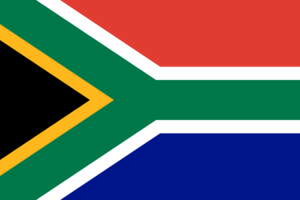
- South Africa: Adopted in 1994 to mark the end of apartheid, with sections of Red, Blue, Green, Yellow, Black, and White. this design uses a “Y” shape representing the convergence of a diverse nation.
- South Sudan: The world’s newest nation has one of the most colorful banners. Adopted in 2011 with horizontal stripes of Black, Red, and Green separated by thin White stripes (fimbriations). A Blue triangle rests at the hoist containing a Yellow star.
US State Flags: The “Seal on a Bedsheet”
When we step away from national flags and look at sub-national regions, the color counts skyrocket. Over half of the 50 US states use a design style known as a “seal on a bedsheet”, a solid blue background with a complex 19th-century state seal.
Because these seals were intended to be official paper stamps rather than waving flags, they feature landscapes, skies, people and animals shaded in dozens of colors.
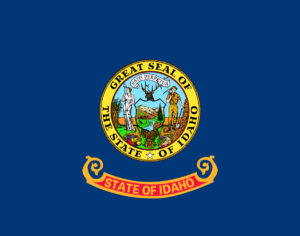
- Idaho: The flag of Idaho is cited by flag enthusiasts as having one of the highest color counts in the world. The central seal has a woman holding the scales of justice, a miner with a pickaxe, a brown elk’s head, green pine trees, a yellow river and a blue sky, totaling upwards of 21 distinct colors depending on the printing.
- Virginia and New Jersey: Similarly, because the Virginia flag features the goddess Virtus standing over a defeated tyrant, and New Jersey features three plows alongside the goddesses of Liberty and Agriculture both flags clock in at over 14 to 15 different shades of color.
Regional Flags: The Ultimate Patchwork
In Europe and the Americas, overseas territories and historic regions often combine multiple older flags into one single banner creating a massive patchwork of color.
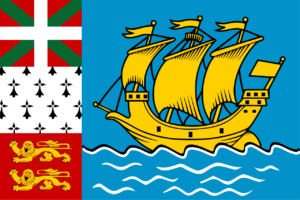
- Saint Pierre and Miquelon: This French territorial collectivity off the coast of Canada flies an unofficial yet highly popular flag that is an absolute explosion of color. It features a golden ship riding on blue waves against a light blue sky. At the hoist there are three smaller flags representing the Basque, Breton and Norman origins of the local population. This heraldic stacking pushes its color count well beyond 12 distinct shades.
Why Break the Rules?
While a simple bicolor flag might be easier to spot from a ship on the horizon, highly colorful flags tell a deeper story. Whether it is Belize honouring its multiracial logging history, South Africa celebrating its diverse unity, or a US State proudly displaying its agricultural seal, these colors prove that sometimes, a nation’s history is just too complex to be explained in a simple stripe.