


When examining the recognized national flags of the world, certain design trends become immediately obvious. Red, white, and blue are dominant, representing everything from the blood of revolution to the freedom of the sky.
Green and yellow also frequently appear to symbolize lush agriculture and vast mineral wealth. But if you look closely at all of these banners, you will notice a glaring omission. So what is the rarest color on a national flag?
The History of Purple in Vexillology
Despite being globally recognized as a color of royalty, wealth, and power, purple is almost completely absent from flags of the world. In fact, out of every independent nation on Earth only two fly a flag with purple on it.
To understand why this is so rare, we have to look back at ancient history, the chemistry of the 19th century, and the hidden details of two modern nations.
Why is Purple So Rare on Flags?
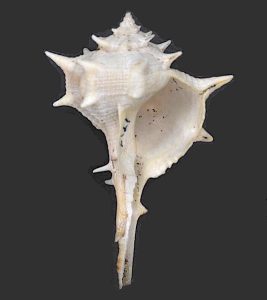
In the ancient world, the Phoenicians controlled the Mediterranean monopoly on a highly coveted pigment known as Tyrian purple (named after the city of Tyre in modern-day Lebanon). Unlike modern dyes made from plants or minerals, Tyrian purple was extracted from the mucus of a type of predatory sea snail called the murex.
The production process was labor-intensive and notoriously foul-smelling. It took the glands of tens of thousands of these sea snails to produce just one ounce of usable dye. Because of this staggering scarcity, Tyrian purple was literally worth more than its weight in gold.
As a result, the color was reserved for the highest echelons of society. In the Roman Empire, wearing purple was heavily regulated, and Queen Elizabeth I of England even passed laws forbidding anyone except the royal family from wearing the color. Because outfitting an entire army, navy, or merchant fleet with purple flags would have bankrupted a kingdom, the color was simply never used in traditional flag design.
The Synthetic Revolution of 1856

Everything changed in 1856 thanks to an 18-year-old English chemist named William Henry Perkin. While attempting to synthesize a cure for malaria in his laboratory, Perkin accidentally created a dark sludge that when diluted with alcohol, produced a brilliant, vibrant purple.
He had accidentally invented mauveine, the world’s first mass-produced synthetic dye. Almost overnight, purple went from being the most expensive color on Earth to a highly accessible pigment.
However, by the mid-19th century, the vast majority of the world’s nations and ancient kingdoms had already established their national flags and heraldic colors. It wasn’t until the late 20th century that modern nations finally began utilizing this once-forbidden color on their national banners.
The Only Two National Flags with Purple
Today, if you want to see the rarest color on a flag, you only have two national banners to look at: Dominica and Nicaragua.
- Dominica: Adopted in 1978 as the Caribbean nation prepared for independence, the flag of Dominica is the most prominent user of the color purple. The center of the flag features a red disc containing a highly detailed illustration of the Sisserou parrot. This endangered bird is the national bird of Dominica, and it is proudly depicted with its distinctively purple chest and head feathers.
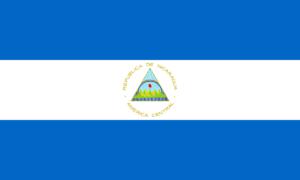
- Nicaragua: To spot the purple on the flag of Nicaragua, you have to look very closely. Adopted in 1908 (officially standardized later), the flag features a coat of arms at its center. Inside the triangle of this coat of arms, above five green volcanoes, is a tiny rainbow. As part of that natural rainbow, there is a band of purple.
What about El Salvador? There is a debate whether El Salvador should be the “third” nation on this list. Like Nicaragua, El Salvador’s coat of arms features a rainbow. However, the country is usually excluded because the purple band in its rainbow is extremely muted, inconsistent, and usually printed simply as blue transitioning directly into red whereas Nicaragua’s purple stripe is clearly defined.
Regional Banners: Spain and the Andes
While modern sovereign nations avoid the color, purple does pop up in a few highly specific historical and regional flags.
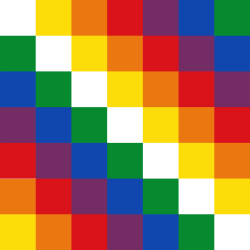
- The Wiphala (The Andes): The Wiphala is a 7×7 square checkered flag used to represent the native peoples of the Andes, co-recognized as an official national symbol in Bolivia. It features a diagonal stripe of purple squares, which specifically represents indigenous government, self-determination, and cosmic harmony.
- The Balearic Islands & Mallorca (Spain): The flag of the Balearic Islands features a distinctive purple canton containing a white, five-towered castle. This same design is also featured prominently on the flag of its island, Mallorca.
The Purple Prefectures of Japan
If you want to see flags that fully embrace a purple background, we can look to the sub-national prefectures of Japan. Japanese flag design often utilizes highly stylized local emblems placed on culturally significant background colors.

- Tokyo: The official metropolitan flag of Tokyo is a stylized white sun resting on a deep purple background (known as Edo murasaki), representing elegance and traditional urban culture.
- Kyoto: The flag of Kyoto Prefecture features a stylized six-pointed leaf (made from the kanji character “京”) resting on a rich purple background.
Three other Japanese prefectures; Gunma, Okayama, and Yamanashi also use solid purple backgrounds to display their stylized white or gold prefectural emblems.
The Legacy of the Rarest Color
The absence of purple on world flags is an interesting quirk of global history. It serves as a reminder of the ancient world’s economy. The next time you look at the purple chest of the Sisserou parrot on the flag of Dominica, remember that just a few centuries ago, printing that exact color would have required a king’s ransom and thousands of sea snails!